You have a catalog in your LMS, an Articulate 360 license coming up for renewal, and a backlog of projects. A compliance module that gets audited. Onboarding that changes every few weeks. Sales training that few people complete.
Each project calls for something different. Genially can be the primary tool for visual, interactive content that needs frequent updates. It complements tools like Storyline when a module needs complex variables, simulations, or custom xAPI statements. It shares some use cases with Canva, Kahoot, and Mentimeter, but it serves a different purpose.
Key takeaways
- Genially is a strong primary tool for onboarding, sales training, microlearning, and frequently updated reinforcement content.
- For compliance training, it fits when SCORM, assessment, and frequent updates are enough.
- Storyline gives you more control over variables, simulations, and custom xAPI statements. For those modules, Genially is a complement.
- Rise, isEazy Author, Easygenerator, and H5P cover linear courses or activities inside the LMS and can coexist with Genially.
- Canva, Kahoot, and Mentimeter share some use cases with Genially, although they specialize in other requirements.
Articulate 360 alternative or add-on: quick comparison by requirement
The table matches each project requirement with the best-fit tool, Genially’s role, and the condition that role depends on. Each row is one requirement.
| Requirement | Recommended tool | Genially’s role | Condition |
|---|---|---|---|
| Frequently updated interactive visual asset | Genially | Primary tool | Plan with SCORM or LTI |
| Nonlinear experience with layers and gamification | Genially | Primary tool | No complex variables |
| Standard compliance training | Genially | Primary tool | SCORM, assessment, and frequent updates are enough |
| Simulation with variables and conditional logic | Storyline | Complement | Genially covers practice and reinforcement |
| Mobile-responsive, block-based linear course | Rise or isEazy Author | Complement | The LMS allows embedded external resources |
| Standardized courses authored by subject-matter experts | Easygenerator or isEazy Author | Complement | Genially provides the assets that go beyond the course |
| Granular, native activity inside the LMS | H5P | Complement | Genially covers the complete visual experience |
| Graphic assets, photos, and video | Canva | Specialized tool for a different requirement | Genially builds the interaction and brings it into the LMS |
| Live competition or poll for a large audience | Kahoot or Mentimeter | Specialized tool for a different requirement | Genially covers the resource people revisit afterward |
How to read the table
Each section ends with a verdict on Genially’s role: primary tool (no other authoring tool needed), complement (it coexists with another tool), or specialized tool for a different requirement (same budget, different need).
The competitor information comes from a competitive analysis based on public sources, with a cutoff date of August 16, 2026. Features change, so check each provider’s documentation before you decide.
Articulate 360: Storyline and Rise
Articulate 360 is Articulate’s suite and includes Storyline and Rise, among other apps. Each app addresses a different requirement, so Genially’s role changes depending on which one you use.
Storyline is designed for highly customized courses, simulations, and assessments with advanced logic. It offers greater depth for variables, states, triggers, and complex branching. It also gives you more control over software simulations, slide timing, and custom xAPI statements.
Rise is a block-based web authoring tool. It lets you quickly create mobile-responsive linear courses and export them to SCORM, xAPI, or cmi5, among other formats. It works best when a course has a stable instructional structure and learners move through it from start to finish.
Its limitation: Rise’s block-based model leaves less freedom in visual composition than an open canvas. The suite is also centered on e-learning courses. It is a weaker fit for infographics, presentations, or assets reused outside the LMS.
Verdict vs. Storyline: complement. Storyline is the right choice for modules that require simulations, deep conditional logic, or custom xAPI statements. Genially handles the communication, practice, and reinforcement around them.
Verdict vs. Rise: complement, provided the LMS and your organization’s policies allow embedded external resources. Genially adds more value when visual freedom, nonlinear navigation, or frequently updated content is the priority.
Linear courses and activities inside the LMS
isEazy Author, Easygenerator, and H5P compete with Genially inside the LMS. The first two produce complete courses. H5P produces individual activities.
isEazy Author and Easygenerator
Both aim to produce corporate courses quickly and without code. The difference is who creates them.
isEazy Author lets you create mobile-responsive, block-based courses. It supports collaboration between authors, provides accessibility guidance during creation, and uses AI to structure the course. It has a strong presence in Spain and Latin America, so it may come up if your organization trains Spanish-speaking teams.
Easygenerator is designed to let subject-matter experts create training without relying on the L&D team. Its strength lies in distributing course authoring and translating courses at scale.
Their limitation: the output is a course. An interactive image, an explorable infographic, or a game that will also be used in a meeting or on the intranet falls outside that format.
Verdict: complement. isEazy Author or Easygenerator is a better fit for distributing the creation of standardized linear courses across many people. Genially is the primary tool when a project calls for open visual composition, layered interactivity, or formats beyond a course.
H5P
H5P is an open technology for creating interactive web activities and reusing them across learning platforms. Its focus is modular activities inside the LMS.
H5P Core is released under the MIT License and requires your own infrastructure: a Moodle, WordPress, or Drupal installation where you install and maintain it. H5P.com is a paid, hosted commercial service with LTI integration, a gradebook, and optional reporting.
Each activity is embedded in Moodle, Canvas, Blackboard, or Brightspace as part of the course, in an open format controlled by your organization.
One budget consideration: the code is open source, but hosting, maintaining, integrating, and supporting it costs money.
Its limitation: each activity is one component within a content type. A complete visual experience with a layered narrative and its own navigation falls outside that model.
Verdict: complement, and the two often coexist. If your team wants granular, native activities inside the LMS, H5P is a better fit. Genially covers the complete visual experience, which you can also use outside the LMS.
Graphic design and live audience engagement
Canva, Kahoot, and Mentimeter share some use cases with Genially and often come up in the same budget discussion. Each one addresses a different requirement.
Canva
Canva is a visual communication suite that brings together design, presentations, documents, video, websites, and AI. It offers a wider range of formats, a resource library, photo and video editing, collaboration, and strong brand recognition. It also includes quizzes, polls, and interactive activities.
Canva Education integrates with several LMSs through assignments. That integration does not necessarily provide a SCORM package or support the same corporate use case. If the module needs to send data to the LMS, verify this before planning the project.
Canva’s pricing page does not confirm SCORM or xAPI export, and Canva Education is free for eligible teachers, students, and schools. That free access does not extend to corporate training departments.
Verdict: a specialized tool for a different requirement. Canva is a better fit for producing graphic assets. Genially is better suited to building the interaction and bringing it into the LMS. They can coexist, and you can connect Canva and Genially to use each for what it does best.
Kahoot and Mentimeter
Kahoot and Mentimeter specialize in live audience engagement. A live session happens once, with the group connected and a facilitator leading it. Persistent content stays published and each person explores it at their own pace. These are two different use cases.
Kahoot is a game-based learning platform for creating live or self-paced quizzes and activities. It stands out for live gameplay, competition, and large-audience events.
Mentimeter is designed for participatory presentations: polls, word clouds, Q&A, anonymous participation, and moderation for large audiences.
Genially includes Present Live. The presenter shares a URL and a six-digit code. Each participant responds from their own device, and a leaderboard appears when the genially includes interactive questions.
Responses are saved in the Activity dashboard, which is not available on every plan. The number of participants allowed per session also depends on the plan.
Verdict: a specialized tool for a different requirement. If the project centers on a quick competition or a large-audience poll, Kahoot or Mentimeter is the right choice. Check their participant limits, which vary by plan. Genially covers the persistent resource people can revisit afterward.
When to choose Genially and when to combine it with another tool
Genially is a no-code platform for creating visual, interactive content. In L&D, it is a strong fit for onboarding, microlearning, sales training, internal communication, and operational training that needs frequent updates. For more instructional context, read about interactive learning and better outcomes.
When to choose Genially
What it covers for content authoring:
- Layered interactivity: windows, tooltips, and content that appears on click.
- Nonlinear navigation: learner-chosen paths, simple branching scenarios, and decision points.
- Assessment and games: interactive questions, quizzes, and gamification.
- Publishing to the LMS: a static or dynamic SCORM package, an xAPI package, and an LTI 1.3 connection.
SCORM downloads and the LTI 1.3 connection are available on Author, Enterprise, Edu 360, and Campus. SCORM downloads are not available on Free, Master, Expert, or Genius. Confirm current availability before purchasing, including xAPI availability.
With dynamic SCORM or LTI, content updates are reflected in the LMS without uploading anything again. Structural changes, such as changing the tracking method, require generating the SCORM package again.
The Help Center article walks through the SCORM download step by step.

HELP CENTER
How to download your Geniallys as a SCORM package
Learn how to download your Genially creations as a SCORM package, step by step.
Onboarding is a good test case. Start from the onboarding presentation template and build a genially for new hires: a welcome page, an interactive org chart where each team opens in a window, tooltips that define internal terms, and a short quiz at the end. Publish it to your LMS as a dynamic SCORM package. When a policy or a contact changes, you edit the genially and the LMS shows the update.
For compliance training, Genially can be a good fit when SCORM, assessment, and frequent updates are enough. If the module requires complex simulations, custom xAPI statements, or specific contractually required evidence, combine it with another tool.
When to combine it with another tool
Combine Genially with another tool when the project depends on any of these four areas:
- Learning management: Genially is not an LMS or a gradebook. Your LMS manages enrollment, learning paths, and grades.
- Simulation logic: it does not provide the branching or variables of a certifiable simulator. Storyline or an equivalent tool is a better fit.
- Analytics: it does not support granular xAPI tracking.
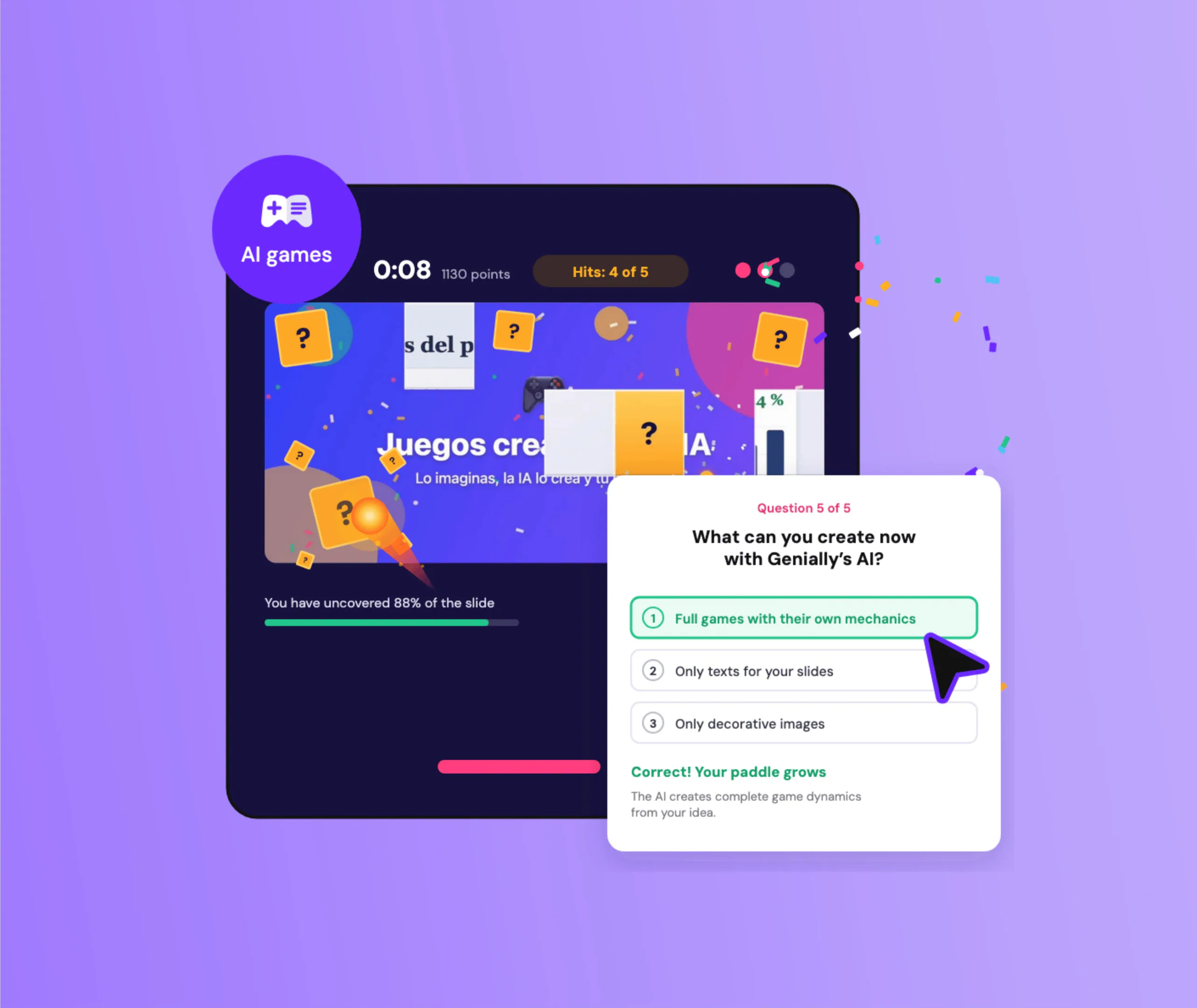
- AI-generated components: they have tracking and accessibility limitations.
If any of these apply, use the other tool for that part. The rest can stay in Genially.
How to decide: four questions
Four questions can help you decide Genially’s role in a project: primary tool, complement, or specialized tool for a different requirement. Answer them before requesting a demo.
- Does the module require conditional logic, variables, or simulations? If yes, it needs Storyline or an equivalent tool. Genially can handle communication and reinforcement.
- Which standard does your LMS require? If it requires xAPI with custom statements, choose Storyline or an equivalent tool. If the SCORM standard, LTI, or an xAPI package is enough, check that the plan you intend to buy includes it.
- Who maintains the content, and how often? If it changes frequently, prioritize updates that do not require generating the package again. If subject-matter experts across the organization maintain it, consider tools designed for them.
- What are the accessibility requirements? In U.S. public-sector procurement, Section 508 conformance can be a disqualifying criterion. A tool’s accessibility features do not guarantee that every creation will be accessible; that depends on how it is built.
The Genially Editor includes accessibility features, and AI-generated components need review before publication. If the procurement process requires an Accessibility Conformance Report (VPAT), request one in writing from each provider. You will find more guidance in the e-learning accessibility guide.
No tool on this list covers every requirement. Start with the project in front of you.
Frequently asked questions
Does Genially replace Articulate Storyline?
For part of your catalog. Genially can be the primary tool for onboarding, microlearning, or frequently updated visual reinforcement. Modules with simulations, deep conditional logic, or custom xAPI statements are a better fit for Storyline or an equivalent tool.
Can I use Genially and my current tool at the same time?
Yes, if the LMS and your organization’s policies allow it. Each tool publishes to the LMS independently. One possible split: keep the regulated module in your current tool and use Genially for communication and reinforcement.
Can I use Genially for simulations?
Yes, for simple branching scenarios and conversation simulations. Nonlinear navigation and decision points let you build them. For software simulations with complex variables, a specialized tool is a better fit.
Where can I see learners’ results?
If you publish with SCORM or LTI, results are sent to your LMS. With LTI, scores sync with its gradebook. Depending on the plan, you can also view responses in Genially’s Activity dashboard.