Did you know that a typical eLearning course has a dismal 20-30% completion rate?
The main culprit is unengaging content. Many L&D courses are still designed around the principle of passive learning—the idea that a learner should just absorb information presented to them in a flat, one-way exchange. Think dull lectures or endless pdfs.
The problem with this approach is that it just isn’t nearly as effective as when learners are truly involved in the learning process. In other words, interactive learning is more effective than passive learning.
This was the subject of our latest webinar with 360Learning (a learning platform based on Collaborative Learning). We figured that the time was right—after months of Zoom fatigue, remote work overload, and endless back-to-back meetings—to share best practices for how to create courses that actually lead to learner retention.
You can check out the replay here or read the highlights, below.
What is Interactive Learning?
Let’s make sure we’re on the same page. What exactly is interactive learning?
We can define Interactive learning as learning that requires the participation of the learner, whether this be through group discussion, interaction with some digital media, or other means. In interactive learning, the learner plays a role and becomes an active participant in the learning process.
Interactive learning is based on the notion that people learn better when they are engaging directly with the material. It’s the opposite of passive learning, in which the student receives information from the instructor and internalizes or memorizes it as is, typically without any feedback from the instructor.

“Tell me and I’ll forget, show me and I’ll remember, involve me and I’ll understand“
Confucious
How we know interactive learning works
There’s a lot of evidence in the academic world that people retain information better when they interact with it. We can mention Edgar Dale’s Cone of Experience, which indicates that people remember approximately 10% of what they hear, 20% of what they read, and 80% of what they see and do.
You may also be familiar with the 70-20-10 rule that suggests that adults learn approximately 10% from coursework and training materials, 20% from feedback and examples, and 70% from challenging, on-the-job experiences.
There was also a fascinating study conducted by academics at the Universities of Washington and Maine about whether interactive or lecture-based (passive) learning was more effective for university students in science, mathematics, and engineering. They not only found that the average examination scores improved by about 6% in active learning sections, but that students in classes with traditional lecturing were 1.5 times more likely to fail than were students in classes with active learning.
So, we’re pretty convinced that active learning methods are more effective. But, when we get down to it, what do we actually mean by L&D courses that use ‘interactive learning’?
What does an interactive training program look like?
There are three main ways to describe a training program that’s based on interactive learning:
- It’s learner-focused
- It’s exploratory (including mixed media)
- It’s immersive
For instance, the training course below (created with Genially) is based on a branched scenario, where the learner has to get involved, poke around, and make choices as to what to do next:
It reminds you of those ‘choose your own adventure’ books you might have read as a teen, doesn’t it? It puts the learner in the driver’s seat, forcing them to explore in an immersive scenario. Definitely an interactive learning experience!
So much for the learner…but what about the trainer? Is there a way for them to have a more interactive, peer-based approach to learning and development? Absolutely—by embracing Collaborative Learning.
Building Interactive Learning into a Collaborative Learning framework
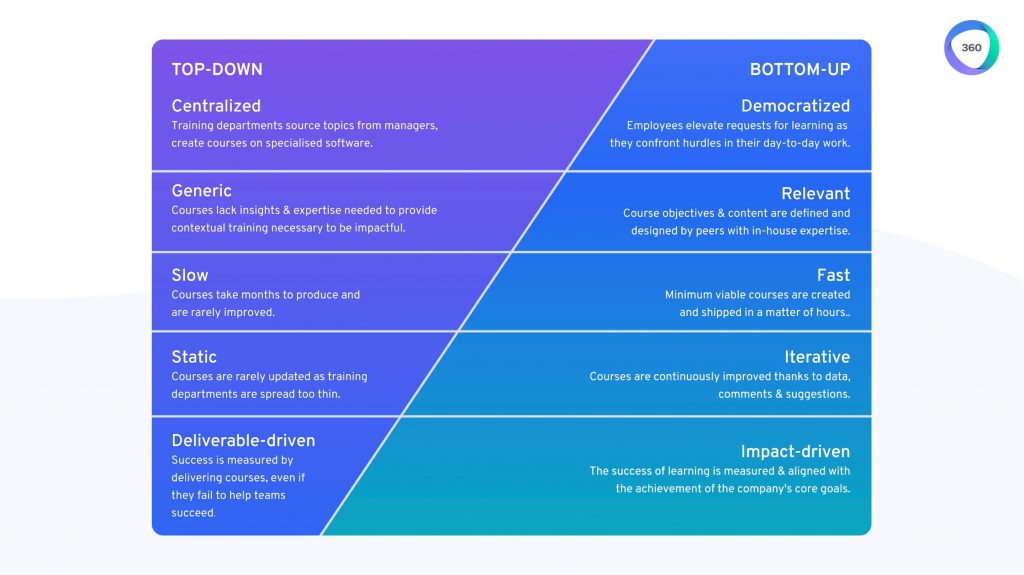
Just like interactive learning is based on imaging the learner as the protagonist, Collaborative Learning centers on the idea that learning should be ‘a team sport’. Instead of a top-down approach where management sets learning expectations, Collaborative Learning is bottom-up, turning individual contributors into subject-matter experts who create, iterate on, and disseminate courses, together:
The benefits of Collaborative Learning
With Collaborative Learning, L&D professionals can:
- Encourage peer feedback loops
- Enable interaction between learner and instructor
- Crowdsource course creation
- Build gamification into courses
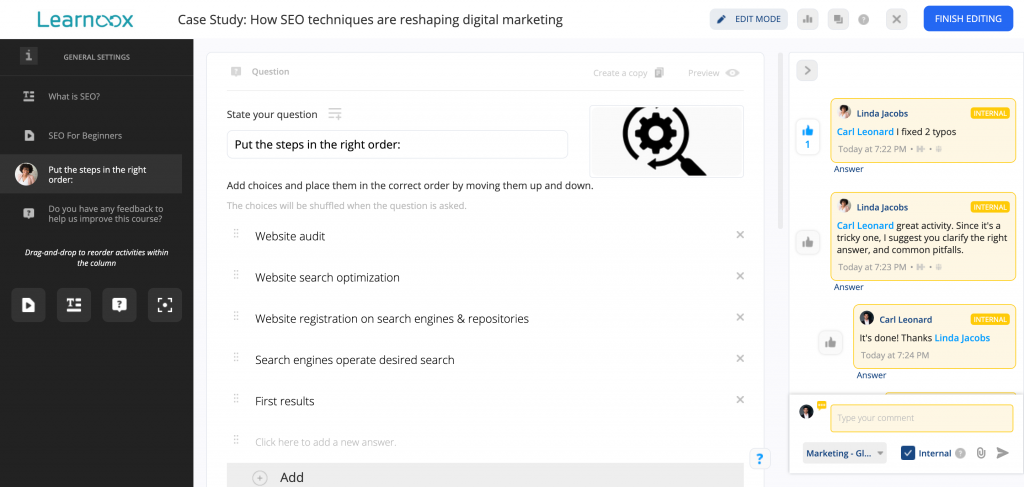
For instance, in the screenshot below, you can see how course creators are able to co-create courses together, iterating on content as they go. A truly collaborative platform will allow content to be updated quickly, so that feedback from course creators, subject-matter experts, and learners can be easily taken into account.
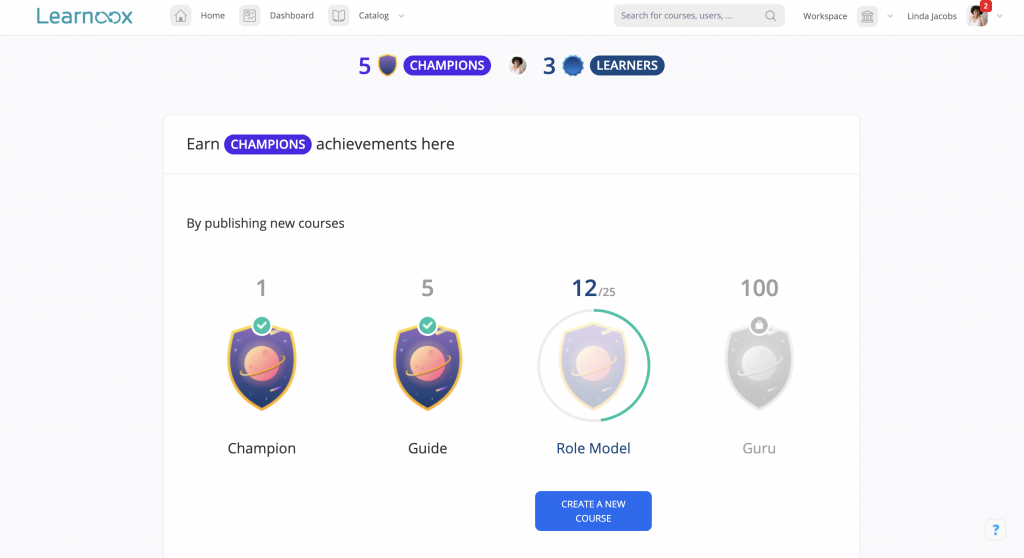
Gamification elements like the leaderboard below also add a touch of fun and community to an L&D program. Badges and recognitions can give that extra nudge needed to motivate a learner to start or finish up a course.
At 360Learning, we’ve absolutely found that using a Collaborative Learning approach leads to higher engagement rates. Specifically, when we looked at how our clients used our platform, we found that:
- Courses that have internal collaboration during the creation process are found 2x as useful by learners.
- Learners find courses that are updated regularly are 27% more useful.
- Questions provoke the highest amount of positive reactions at a staggering 75.9% conversion.
In a nutshell: the more communal, interactive, and relevant courses are, the better they perform. And that’s what Collaborative Learning is all about.
How 360Learning and Genially work together to make interactive learning easy
If you want to put training courses that are interactive and collaborative in place, you’ll need the right tools. Good thing Genially and 360Learning have a built-in integration, so you can add an interactive Genially presentation into 360Learning by copying and pasting an embed code. It’s that simple.
If you’re interested in learning more about interactive learning, Collaborative Learning, or how Genially and 360Learning make it easy to put into practice all the tips we’ve just seen, don’t hesitate to check out the webinar replay, which includes a demo of our platforms’ integrations.