There’s a “pretty” problem in corporate learning and development: we spend weeks perfecting color palettes, animations, layouts, and interactions. The result? A polished training module that gets a thumbs-up from stakeholders… but doesn’t necessarily change what anyone does at work.
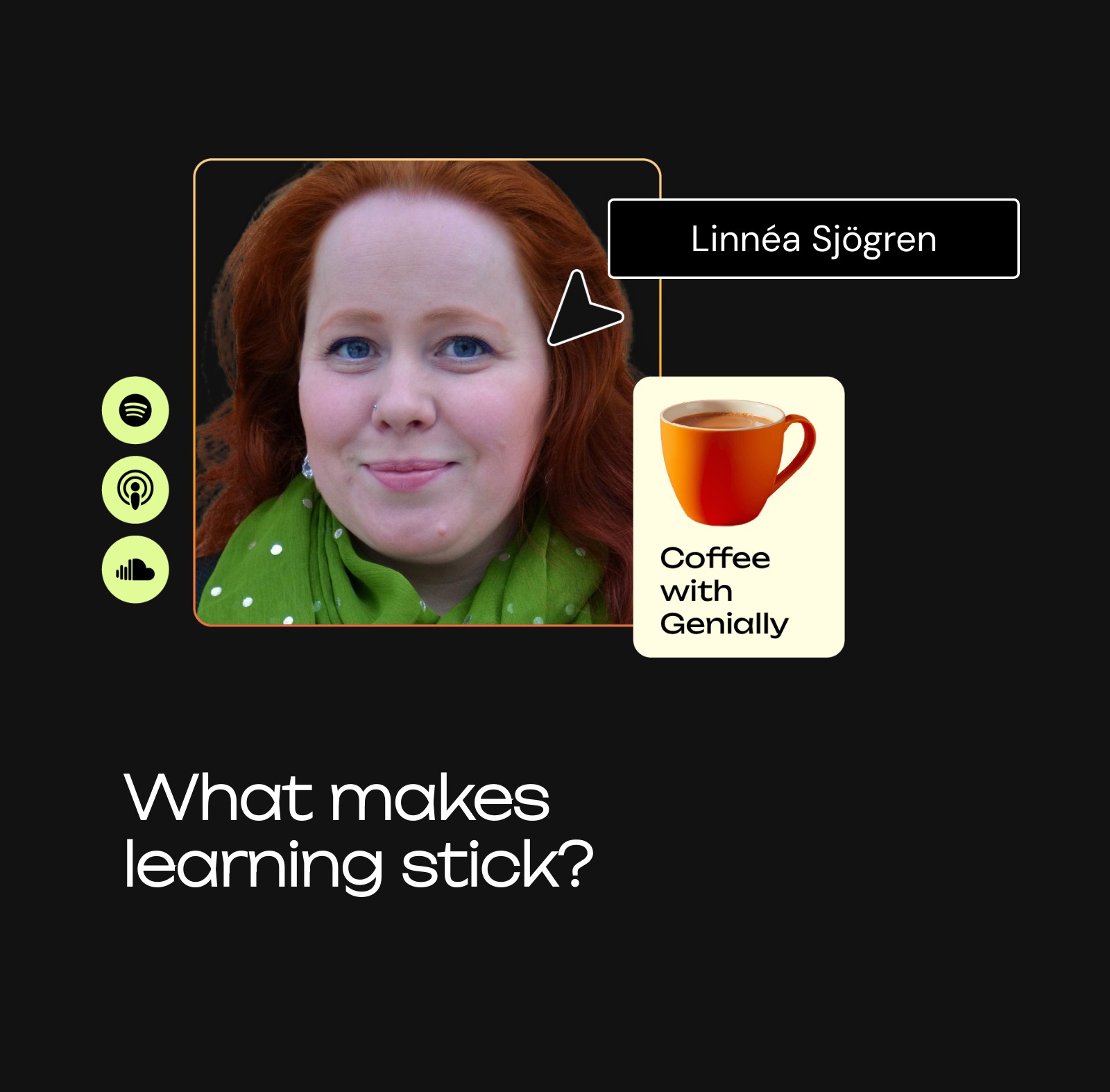
Instructional designer Linnea Sjogren knows this feeling well. Looking back at some of her early projects, she remembers creating “pretty and beautiful” training simply because that’s what she had been asked to do. The learning looked great. The impact? Not so much.
The lesson is an important one: meaningful learning isn’t about making training prettier. It’s about designing experiences that help people think, practice, decide, and ultimately perform differently.
And sometimes, achieving that means questioning some of the most common assumptions in L&D.
Meaningful learning in a nutshell
Meaningful learning happens when people actively connect new information with what they already know and can apply it in a relevant context.
For L&D and instructional design teams, that means looking beyond course completion and asking a more useful question: What should change after this learning experience?
In practice, effective learning experiences tend to:
- solve a real performance or knowledge problem;
- fit naturally into people’s day-to-day work;
- make information easy to access without oversimplifying the challenge;
- encourage people to think and make decisions;
- use interactivity with a clear learning purpose;
- combine technology with human expertise and sound instructional strategy.
With that in mind, here are five ideas that can change the way you approach your next training project.
1. Training isn’t a Band-Aid. It’s a precision tool
A performance problem appears. Someone says: “We need a course.” Sound familiar? It’s one of the most common reflexes in organizations. But not every performance gap is a learning gap, and training isn’t the right solution to every business problem.
This is where instructional designers and L&D professionals can create enormous value before they build a single slide.
Ask questions. Investigate the problem. Find out what people actually need to do differently. And, when necessary, say no to training. Because sometimes the best learning solution isn’t a course at all.
The 70-20-10 model is a useful reminder to think beyond formal training and consider how learning happens through experience, collaboration, and day-to-day work.
Instead of another module, the solution might involve:
- updating a technical manual so information is easier to find;
- creating an internal communication strategy;
- providing managers with coaching resources;
- adding job aids or performance support directly into the workflow;
- combining formal learning with opportunities to practice on the job.
The goal isn’t to create more training. It’s to create the conditions for better performance.

“Training alone rarely gives an effect. It’s combining that with other transfer tools and involving the business, making it part of their day-to-day life… that will actually have an effect.” — Linnea Sjogren
That shift changes the role of instructional design too. You’re no longer simply building what was requested. You’re helping identify what will actually work.
2. Ineffective training costs more than you think
When we calculate the cost of a training project, it’s easy to focus on production: tools, development time, design resources, and external suppliers. But ineffective training comes with another bill. And much of it is invisible.
The hidden cost of SME time
Subject Matter Experts are usually involved because their knowledge is valuable. Every hour they spend reviewing an unnecessary course is an hour they’re not spending on other high-value work.
Before pulling SMEs into weeks of production, make sure the learning intervention is solving the right problem.
The cost of learner attention
Attention is a limited resource. Ask people to complete irrelevant, repetitive, or passive training often enough and you’re not just wasting their time. You may also be teaching them that training is something to click through rather than something worth engaging with. Not exactly the learning culture anyone is aiming for.
The cost of false confidence
This may be the biggest risk of all. A course gets published. Everyone completes it. The dashboard turns green. Problem solved? Not necessarily.
A completion metric tells you that someone reached the end of an experience. It doesn’t tell you whether they can apply what they learned or whether their behavior changed. Meaningful learning requires measuring what happens after the click.
3. Make the language simple, not the learning
Should learning be easy? Yes… and no. The experience should be easy to navigate and understand, but that doesn’t mean the thinking should be effortless. That distinction matters.
Imagine you’re creating training for a diverse workforce with different levels of language proficiency. Complex sentences, unnecessary terminology, and confusing navigation add cognitive friction without adding learning value.
Remove that friction.
Use:
- simple, direct language;
- clear visual cues;
- images and video when they improve understanding;
- intuitive navigation;
- accessible content formats.
But don’t remove the intellectual challenge.
Whether someone is learning about chemical safety, customer service, or structural engineering, they still need opportunities to retrieve information, make decisions, solve problems, and apply concepts. That productive struggle is where learning happens.
Choice can help too. Giving people different ways to engage with content, such as watching an explanation or trying an activity, can add autonomy to the experience and connect with principles from Self-Determination Theory.
So simplify the interface. Simplify the instructions. Don’t simplify the thinking.
4. Meaningful learning needs meaningful interactivity
Here’s a tiny L&D reality check: Clicking isn’t the same as interacting.
A learner clicks a card. A title appears. They click another card. More text appears. Technically interactive? Sure. Meaningful? Not necessarily.
When an interaction exists only to reveal information that could have been visible from the beginning, it can quickly become an extra chore.
Meaningful interactivity asks the learner to do something mentally, not just physically. That could mean predicting an outcome, retrieving information, making a decision, comparing options, or solving a problem.
And one particularly effective way to encourage that thinking is to leave the comfortable world of obvious right and wrong answers.
Think about a customer service scenario. An angry customer arrives with a complaint. You offer three responses:
A. Listen and acknowledge their frustration.
B. Tell them they’re wrong and walk away.
C. Solve everything perfectly in one sentence.
Nobody needs much training to spot the answer there. Instead, create three plausible responses. Each one should have advantages, limitations, and consequences. Now the learner has to stop, think, compare and decide.
Then, instead of simply showing “Correct!” or “Try again,” give specific feedback explaining what could happen as a result of each decision. That’s where branching scenarios, simulations, and interactive learning experiences become genuinely useful. The interaction isn’t decoration. It creates space for decision-making and reflection. And that’s a much better reason to click.
5. AI can accelerate course creation, but it can’t replace learning strategy
AI can now turn source material into learning content incredibly quickly. Upload a PDF. Generate some questions. Create a structure. Done. Fast? Absolutely. Enough? Not quite.
The risk is what we might call “wham-bam” course creation: generating training at high speed without first asking whether the training should exist, what problem it solves, or what learners need to do differently afterward.
AI is excellent at following instructions. And that’s precisely why human expertise still matters.
An AI tool might help you:
- brainstorm scenarios;
- generate alternative question formats;
- simplify or adapt language;
- organize source material;
- explore different ways to present an idea.
But it won’t automatically challenge the strategic assumptions behind your request.
Should this be a course? Is this activity actually helping someone learn? Does this scenario reflect what happens in the real world? Will completing this experience change performance?
Those questions need instructional judgment, context, and a clear understanding of the people involved. Think of AI as a creative collaborator that can accelerate parts of your workflow, while the learning professional stays firmly in charge of the strategy.
From course completion to actual change
The future of meaningful learning isn’t about adding more content, more clicks, or more courses. It’s about designing with intention. Start with the problem. Make information accessible. Keep the cognitive challenge. Build interactions that make people think. Use AI where it adds value, while keeping human expertise in the loop. Most importantly, measure what matters.
Here’s a small experiment for your next learning project:
Replace one standard quiz with a gray-area scenario. Create a realistic situation and give learners three plausible, “semi-good” choices. Then provide specific feedback for every path.
See what happens when the goal shifts from finding the correct button to making a thoughtful decision. Because the most useful question at the end of a training experience isn’t: “Did they complete it?” It’s: “What can they do differently now?”
Ready to create more meaningful learning experiences? Start with one interaction, one decision, and one real-world challenge your learners actually need to solve.