There’s a question many teachers ask themselves at some point: when was the last time a student left class genuinely wanting to know more?
Not because they had to. Not because there was a test coming up. But because something had sparked their curiosity for real.
That’s exactly what’s been happening in the classrooms of educators who have combined Intel® Skills for Innovation Starter Packs with Genially. And the stories they’ve left behind are worth telling.
From AI storytelling in Utah to eco-engineering in Macedonia, these educators are transforming classrooms into interactive hubs of exploration.
These stories reveal how digital tools can empower students to design, experiment, and imagine the future, one interactive lesson at a time.
How Interactive Technology Is Transforming Classrooms Worldwide
For years, technology in the classroom mostly served to do the same old things, just on a screen. Prettier presentations, videos instead of photocopies. The backdrop changed; the dynamic, not so much.
What happens when students stop being passive viewers and start becoming the architects of their own learning?
Across today’s most forward-thinking classrooms, technology isn’t just a medium for sharing information; it’s a catalyst for exploration, a space where students create, experiment, and reimagine knowledge for a world defined by rapid change.
Together, Intel® Skills for Innovation (SFI) and Genially provide the tools and framework that support this evolution. Intel SFI provides curriculum materials on AI, data science, design thinking, digital storytelling, and more. Genially offers the interactive canvas where those ideas come to life. Together, they allow students not just to receive information but to simulate, experiment, build, and actually do something with what they learn.
This post celebrates the creativity of educators who joined the Genially × Intel® Skills for Innovation Teacher Competition. From digital classrooms to engineering labs, these teachers are proving one thing: when high-level curriculum meets interactive design, students don’t just learn about the future, they start building it.
1. Teaching Creative Writing with AI (and understanding why human writing is different)
Jayne Jones is an ELA teacher at Mountain Heights Academy, a public charter school in Utah that runs in a fully asynchronous environment. Without a physical classroom, without the spontaneous energy of in-person learning, getting students genuinely invested in Creative Writing is no small feat.
Her solution was to use the “Figuratively Speaking” Starter Pack and design a Genially presentation with a futuristic aesthetic, not for the sake of looking impressive, but so that students would associate AI with creative possibility rather than cold technical processes.
To spark imagination, she used AI Dungeon, a storytelling template where students co-create stories with AI. Her Genially design was built for online engagement, using hide and reveal features, windows and interactive questions to encourage exploration and clickable interactions to guide learning at each student’s pace.
The result was unexpectedly revealing. By analyzing the AI-generated texts, students began identifying what was missing: emotional depth, rhythm, something hard to name but easy to notice. AI didn’t replace their writing; it helped them understand why their own voice mattered and used AI as a creative co-pilot, not a replacement for their imagination.
“It gives me ideas that I might otherwise have never thought of,” one student shared.
“It made it more fun… almost like a choose-your-own-adventure game,” added another.
Genially Expert Insight:

“Outstanding example of using Genially for teaching & learning!” – Olga Kazarina, Customer Success Manager and Community Builder at Genially.
2. Building STEM Skills Through 3D Design and Engineering
In Macedonia, Silvana Jakimovska adapted the “Giants in the Sky” project to her local curriculum, translating all the materials into Macedonian and solving a practical obstacle along the way: her students couldn’t use Blender, the 3D design software originally planned. She replaced it with Tinkercad, more accessible for her context, and refocused the experience on design principles and mathematical reasoning.
She used Genially’s interactive windows and tooltips, along with widgets such as carousels and interactive cards, to present the content in a visually appealing and easy-to-navigate way. She also used a randomizer to assign surprise modeling tasks, turning engineering into a game of creativity. Through interactive cards and carousels, students explored aerodynamics visually and intuitively.
After finishing their 3D models, students built real skyscrapers using recycled materials like cardboard and plastic bottles, comparing the stability of their digital designs with their real-world structures. It was a perfect blend of STEM logic, environmental awareness, and hands-on learning.
“Can we learn more things like this again?” one student asked. A sign that curiosity had truly taken flight.
Genially Expert Insight:
“Great strategic shift from Blender to Tinkercad. Prioritizing Design Thinking over technical hurdles was a smart move, and Genially effectively bridged the gap between digital design and physical prototyping.” – Olga Kazarina, Customer Success Manager and Community Builder at Genially.
“Smart adaptation of Tinkercad and very good use of Genially features to create student engagement.” – James Flaskamp, Community Builder at Genially.
3. A STEAM Journey: From Curiosity to Creation
The “SOS Water” project by Francisco Delgado, based on the Water Pollution Starter Pack, turned elementary students into “Super Planetary Agents”. Their mission? To solve water scarcity and pollution using a mix of science, coding, and robotics.
In this STEAM-based approach, blending science, technology, robotics, and programming into one powerful learning experience, students followed a structured path:
- Motivation & Research: Students investigated the causes of water pollution and explored global issues like the Great Pacific Garbage Patch, linking them to real-world human impact.
- Storytelling with Scratch: They used Scratch to design animations and mini-games, sharing their ideas on how to reduce pollution through creative storytelling.
- Machine Learning in Action: Through a simple experiment with eggs and vinegar, students trained a machine learning model to classify water acidity by color.
- Robotics & Real-World Impact: Finally, they built and programmed a LEGO all-terrain vehicle to collect water samples and analyze pH levels, simulating field research in extreme conditions.
“It worked very well to create a powerful narrative, transforming the students into ‘Super Planetary Agents’. This generated more significant and accessible learning,” shared the project educator.
What made the project work wasn’t just the technology, it was the narrative wrapped around it. Students weren’t completing exercises; they were on a mission.
Genially Expert Insight:
“Impactful lesson with some evidence with published articles in newspapers and around the world.” – Olga Kazarina, Customer Success Manager and Community Builder at Genially.
4. Exploring AI and IoT in Sustainable Farming Projects for Middle School Students
Gumrah Sahin works with the IB Middle Years Programme and chose to tackle the global food crisis from a hands-on angle: how could IoT sensors and machine learning improve hydroponic farming systems?
Students designed smart system prototypes, trained models using plant images, and learned to read sensor data. Genially let them navigate the flow of water, nutrients, and light in a visual and interactive way, with clickable hotspots, animations, gamification and progress indicators.
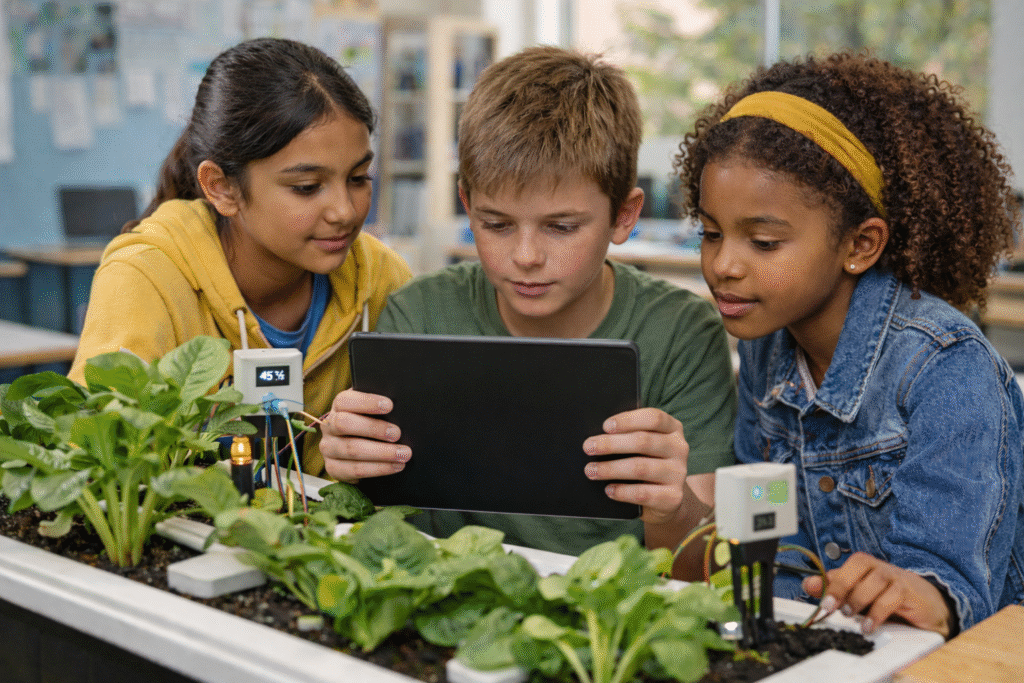
📷 AI-generated illustration of students prototyping a smart hydroponic farming system.
Students dove into the prototyping phase with excitement, using IoT sensors and AI tools to design smart solutions. Connecting real-world challenges like food scarcity with technology made learning feel purposeful and alive.
“It’s amazing to see how machine learning can predict plant health. I trained my model with 50 images, and it correctly identified healthy vs. unhealthy plants!” one student said proudly.
By mapping Intel SFI resources to the MYP Design Cycle, students didn’t just learn code; they learned data ethics, environmental responsibility, and real-world application.
5. Teaching Environmental Science with AI and Computer Vision Tools
In the “Plastic, Plastic, Everywhere” project, Vineeta Garg wanted her students to use OpenCV and Google Colab to detect microplastics in images. The challenge: the conceptual leap was enormous. Going straight to code would have left many of them behind.
To ease the technical challenge, she created a Genially Escape Room paired with Flip-card Quizzes, letting students practice image-processing logic, from thresholding to noise removal, without writing a single line of code. The gamification wasn’t decorative; it was the scaffolding.
“The escape room helped me finally understand the order of image processing,” shared one student.
Gamification made the complex accessible and students began seeing everyday challenges through the lens of AI, learning to explore problems rather than fear them.
By the end, 90% of participants said they now feel ready to tackle real-world issues using artificial intelligence. That’s not a small thing for students who, just weeks earlier, had seen AI as an impenetrable black box. That’s a clear sign of growing confidence and curiosity.
Genially Expert Insight:
“Excellent work on the templates. What stands out is the focus on the “why” and the “how’ “of student learning.” – Olga Kazarina, Customer Success Manager and Community Builder at Genially.
“Skillful adaptation of Genially templates!” – James Flaskamp, Community Builder at Genially.
6. Learning to Code Through Music: A Creative Approach to STEM Education
Gjorgjina Dimova, an Informatics and Technical Education teacher, started her project “Music Through Coding” with something as analog as clapping. Before touching a single computer, students practiced rhythmic sequences, built “sandwich algorithms,” and physically ordered steps. She brought together logic, rhythm, and creativity.
After mastering basic sequencing, she used Genially interactivity, animations, interactive questions, gamification elements, and visuals. She created a drag-and-drop activity where students arranged the steps of a sandwich-making algorithm in the right order, a fun way to practice sequencing logic before diving into coding.
“If I change this number, the music changes — that’s so cool!” a student exclaimed.
Step by step, logic turned into melody, and algorithms became art. Programming stopped feeling abstract because it had an immediate, sensory result. The algorithm wasn’t a concept; it was a song.
Genially Expert Insight:
“Impressive scaffolding. Restructuring the “Music Through Coding” pack with Genially’s drag-and-drop features created a highly accessible path. The use of differentiated tasks effectively ensured all students reached mastery at their own pace.” – Olga Kazarina, Customer Success Manager and Community Builder at Genially.
What the Future of Learning Looks Like with Intel® Skills For Innovation and Genially
From microplastics to music, from AI narratives to hydroponics, these classrooms prove that when Intel® SFI and Genially come together, traditional subjects dissolve into interdisciplinary learning experiences.
Teachers are evolving too, from lecturers into learning designers and guides, shaping environments where curiosity thrives.
In every example, we see the same pattern: technology becomes a bridge between ideas and action, between imagination and understanding.
The next generation isn’t just learning about innovation; they’re learning through it.
Now it’s your turn: How could you bring your next lesson to life with Intel® SFI and Genially?